



【Shenzhen University Medicine Forum】:The Basic Framework of Cellular Regulation of ROS: Pathways and Levels
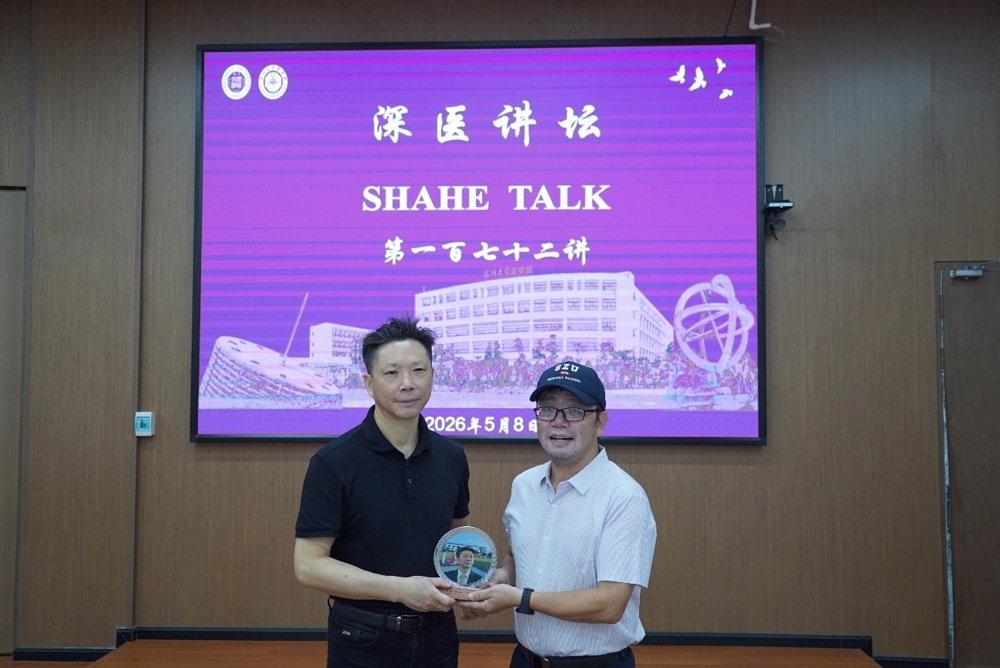
On the morning of May 8, 2026, at the invitation of Professor Chen Xinchun from the School of Basic Medicine, Faculty of Medicine, Professor Huang Bo from the Chinese Academy of Medical Sciences (President of the Chinese Society of Immunology and Chair of the Committee on Tumor Biotherapy of the Chinese Anti-Cancer Association) served as the guest speaker for the 173rd lecture of the “Shenzhen Medical Forum.” He delivered an academic presentation titled “The Basic Architecture of Cellular Regulation of ROS: Pathways and Levels” at Building A7, Shahe Yuan, Lihu Campus, Shenzhen University.
Intracellular ROS primarily exist in the form of H₂O₂, and their elimination relies mainly on NADPH molecules. Two NADPH molecules donate two hydrogen atoms to H₂O₂, generating two molecules of H₂O, thereby eliminating the free radical. While this method of free radical scavenging is both simple and clean, the production of NADPH is a complex process. This is primarily because NADPH production is regulated by glycogen metabolism; the 6-phosphoglucose produced by glycogenolysis enters the pentose phosphate pathway, leading to the generation of NADPH.
Professor Huang Bo’s research group is dedicated to investigating the underlying mechanisms of tumorigenesis, tumor progression, and cancer therapy. The team has conducted in-depth analyses of the mechanisms by which tumor cells evade innate and T-cell-mediated immune responses, and based on these findings, has innovatively developed a drug-loaded vesicle technology. This technology leverages the soft characteristics of tumor stem cells to achieve targeted drug delivery, thereby killing drug-resistant cells while activating the systemic immune response. Furthermore, the group has expanded its research into the fields of biomechanics and metabolism, elucidating how the physical microenvironment and metabolism regulate tumor stemness and immune responses, thereby providing multidimensional scientific evidence for cancer therapy. During this forum, Professor Huang Bo first guided us through a review of the pathways for reactive oxygen species (ROS) generation. Intracellular ROS production primarily originates from four major physiological pathways: First, the mitochondrial respiratory chain serves as the primary source; during the oxidative metabolism of carbohydrates and lipids, a small portion of oxygen (approximately 2–5%) undergoes incomplete reduction in the electron transport chain, generating superoxide anions. Second, the NADPH oxidase pathway, primarily found in immune cells, produces large amounts of superoxide anions through a “respiratory burst” mechanism to execute immune defense functions. Third, during protein synthesis in the endoplasmic reticulum, the oxidative folding reaction produces hydrogen peroxide as a byproduct to form correct protein disulfide bonds; finally, in the purine metabolic pathway, xanthine oxidase catalyzes the conversion of hypoxanthine and xanthine into uric acid, a process that is also accompanied by the generation of superoxide anions and hydrogen peroxide. He provided an in-depth analysis of ROS production pathways in mitochondria, explaining that during the electron transport chain’s conversion of electron kinetic energy into proton potential energy, approximately 5% of oxygen combines with electrons to form superoxide anions, serving as a major source of ROS. Regarding the antioxidant system, Professor Huang Bo proposed that NADPH is the core of the antioxidant system and acts as the “currency of the redox world.”
Professor Huang Bo emphasized that cells rely on changes in ROS to achieve proliferation, differentiation, functional expression, and homeostasis maintenance, the essence of which is the regulation of energy metabolism. Cells depend on ATP production and hydrolysis for survival, yet they die due to the energy-limiting effects of ROS. The intracellular pathways and hierarchical levels regulated by ROS represent the most fundamental manifestation of cellular life, and deviations in these processes serve as the underlying drivers of chronic inflammation, tumors, and autoimmune diseases in the human body. This discovery offers a novel perspective for understanding cellular metabolism and the mechanisms of disease onset, while also pointing the way toward the development of diagnostic and therapeutic strategies for related diseases.
Huang Bo is a tenured professor at the Chinese Academy of Medical Sciences & Peking Union Medical College. He serves as President of the Chinese Society for Immunology and Chair of the Committee on Tumor Biotherapy of the Chinese Anti-Cancer Association. His laboratory focuses on cutting-edge interdisciplinary research in tumor immunology, immune cell metabolism, biomechanical signaling, tumor dormancy, and tumor vesicles, seeking to address core questions regarding tumors, changes in human physiology, and aging. He has published over 90 papers as the sole or corresponding author in journals such as Science, Nat Immunol (4), Nat Cell Biol (4), Immunity, Sci Immunol, Cancer Cell, Nat Mater, Nat Metab, Nat Chem Biol., Sci Transl Med (2), Mol Cell (2), and Nat Biomed Eng (2). A novel tumor immunotherapy technology—drug-loaded tumor vesicles—developed entirely through independent research has been included in the National Health Commission’s Technical Specifications for National Medical Service Projects (2023 Edition)for the treatment of malignant pleural and peritoneal effusions, postoperative recurrence and metastasis, and various types of cancer.
用户登录
还没有账号?
立即注册